
edithbertrand.com
edithbertrand.com
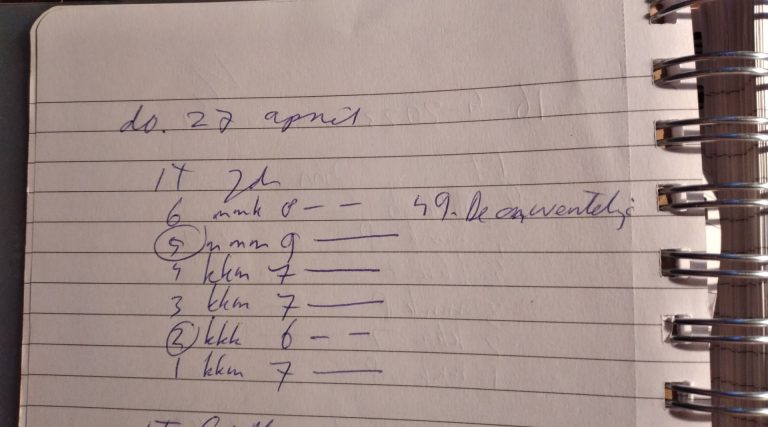
A note with my old counting
For those who want to try it themselves, here is how to cast the I Ching (there are probably other methods as well). You need three small coins of the same type. The tails side has a value of two, the heads side has a value of three. I didn't know this for years and did it the other way round. No problem, the I Ching adapts to this. As long as it is clear in advance which side has which value for you. If in doubt, you can make a note of this, then you can be sure that everything will be fine. In yin-yang philosophy, tails has a value of 2 and heads has a value of 3.
You toss six times and write down each toss, placing the first toss at the bottom, the second toss above it, the third toss above that, and so on. So you get:
Each throw is either 333=9 or 332=8 or 322=7 or 222=6.
For a six and an eight, draw two horizontal lines next to each other (a broken horizontal line). For a seven and a nine, draw one unbroken horizontal line. A broken line is called a weak line in the I Ching, an unbroken line a strong line. (A broken line is also called a negative line, an unbroken line a positive line.)
A weak line (broken) can be moving or resting. The same applies to a strong line (unbroken). A line is moving if three of the same sides of the three coins are thrown in a toss. That is, when a toss consists of three twos (six) or three threes (nine). A line is resting when three identical sides of a coin have not been thrown, i.e. a three and two twos (seven), or a two and two threes (eight).
For each toss, write down one of the four options:
heads heads heads = 3 + 3 + 3 = 9 = an unbroken moving line;
or heads heads tails = 3 + 3 + 2 = 8 = an broken resting line;
or tails tails heads = 2 + 2 + 3 = 7 = an unbroken resting line;
or tails tails tails = 2 + 2 + 2 = 6 = a broken moving line.
When you draw this out, you will have your hexagram that applies to your situation. There are 64 hexagrams. The hexagrams are listed at the front of the book, and you can choose your number. The top three lines are in the horizontal bar, and the bottom three lines are in the vertical bar.
So you can always read the explanation of the sign, the Judgement and the Image. Perhaps you do not have a moving line. In that case, only the Judgement and the Image apply to your situation. If you have one or more moving lines, those lines have a strong influence on the interpretation because they are highly charged. Therefore, if you have moving lines, you should not jump to conclusions when interpreting the Judgement and the Image, because the lines are moving, which means they are very important, as they provide more specific information for you.
Are you considering using the first part of the explanations of the 64 hexagrams in the book, rather than the second part?
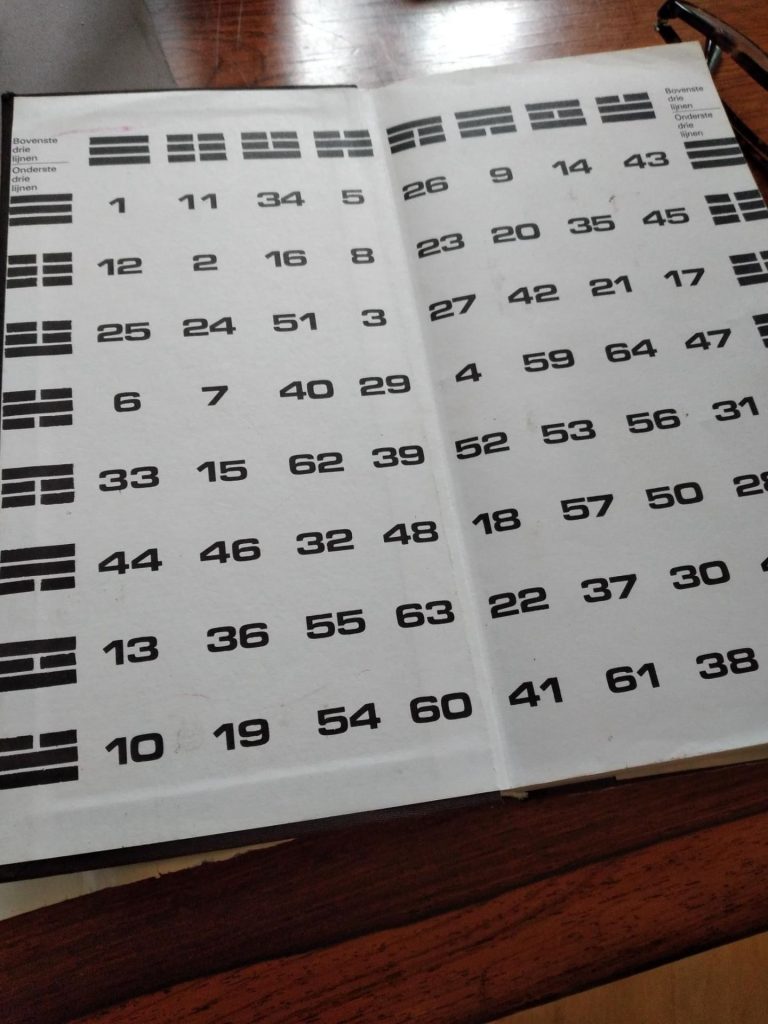
A German and an English translation of the I Ching based on Richard Wilhelm's translation are available online. I have not found a Dutch translation based on Richard Wilhelm's translation. You can read any hexagram from the I Ching to get an impression of the language used in the I Ching.
The link to the German translation: https://schuledesrades.org/public/iging/buch/
The link to the English translation: https://www.wisdomportal.com/IChing/IChing-Wilhelm.html
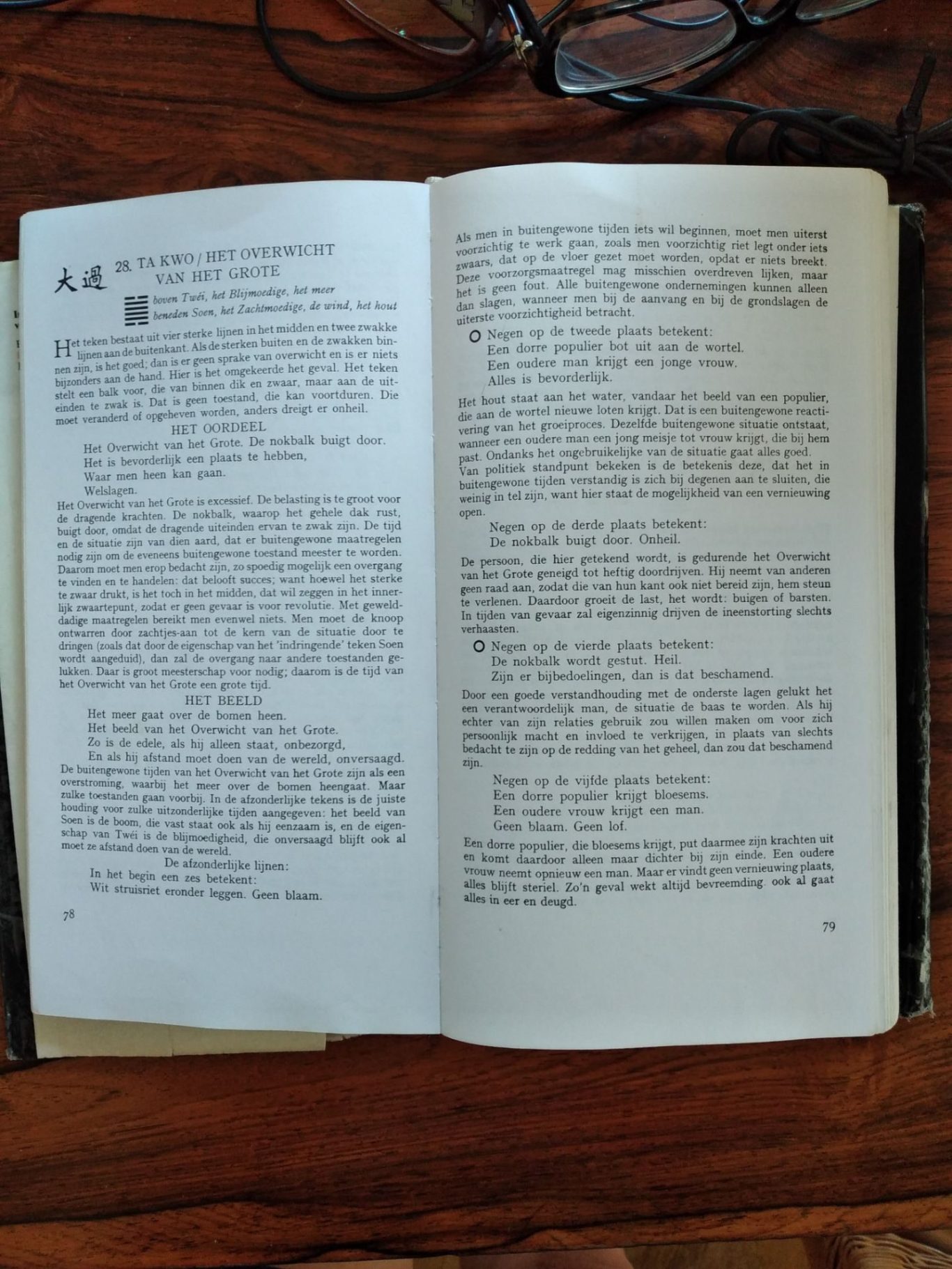
Each hexagram begins with an explanation of the two trigrams that comprise it. You will not be able to glean much from this. Next comes a text called ‘The Judgement’, then a text called ‘The Image’, and then the texts of the individual lines, which you only read if you have thrown moving lines in your cast. The Judgement, the Image and the individual lines begin with a saying, which is often incomprehensible to us. This is followed by an explanation of that saying. That is all you have to go on. That is what the I Ching says about your situation. Applying and understanding this properly requires practice and patience, although some I Chings will be immediately clear to you.
We hebben je toestemming nodig om de vertalingen te laden
Om de inhoud van de website te vertalen gebruiken we een externe dienstverlener, die mogelijk gegevens over je activiteiten verzamelt. Lees het privacybeleid van de dienst en accepteer dit, om de vertalingen te bekijken.