edithbertrand.com
edithbertrand.com
I use two different ritual ancestor constellations as a basis: the thematic and the general ancestor constellation. A thematic ancestor constellation is suitable if you want to highlight a specific issue or theme that is primarily linked to one of your four ancestral lines. In the thematic ancestor constellation, you choose in advance which of the four ancestral lines you want to set up: that of your mother and her mother, that of your mother and her father, that of your father and his mother, or that of your father and his father. If you do not have a specific theme for one of the four ancestral lines, you can opt for the general ancestor constellation. In the general ancestor constellation, you place stones for all four ancestral lines. This means that all four ancestral lines are set up.
It may be a good idea to realise right away that in a thematic ritual ancestor constellation, it is not your theme that is being addressed, but that of your ancestors. It is and always will be an ancestor constellation. Ancestors have their own issues that they want to express. You can present your theme or questions to them, but you cannot ask them for advice. They express themselves about their own lives and they determine for themselves what they want to reveal about themselves. Further details on this can be found in the various texts under 'Ancestor constellations'.
In order to give all the energies involved time to prepare for the constellation, it is desirable that the choice of ritual form be finalised a week before the constellation takes place. Therefore, please let me know which ritual you would like no later than a week before our appointment. Other ritual forms are listed further on, under the heading ‘Customised ritual ancestor constellations’.
The thematic ancestor constellation looks like this:
You lay out one of the four ancestral lines.
First generation, you choose mother or father: 1 stone in the middle.
Second generation, you choose grandmother or grandfather: 1 stone in the middle.
Third generation, one great-grandparent and the other: 1 stone in the middle, the other to the left of it.
Fourth generation, 3 ancestors from this line: 1 stone in the middle, the second stone to the left of it, the third stone to the right of it.
Continue in this way up to the tenth generation.
The order in which the stones are laid doesn’t really matter, as long as it’s right in the end. You place the stones far enough apart that you can stand between them when you pick up a stone to tune into it.
In the thematic constellation, the order in which ancestors appear is fixed. The first generation first, then the second generation, and so on. And within the row of a single generation, first the middle stone, then the left-hand stone, and thirdly the right-hand stone.
In the ritual of picking up, tuning in and representing the stones, we work with stones up to and including the fourth generation. That amounts to seven ancestors. This is sufficient for the process. Generations five through to ten are included as well. It is always possible that an ancestor from a particular generation may come to the fore. This will become apparent when a stone from that generation strongly draws your attention. Usually this will not be the case, but their explicit representation in stones is still helpful.
In the third generation, both ancestors may come to the fore. From the fourth generation, not every ancestor belonging to that generation will come to the fore; only a maximum of three will do so. Which ancestors present themselves will depend on what you and they need at this moment and what may be meaningful.
Below is a photo of this.
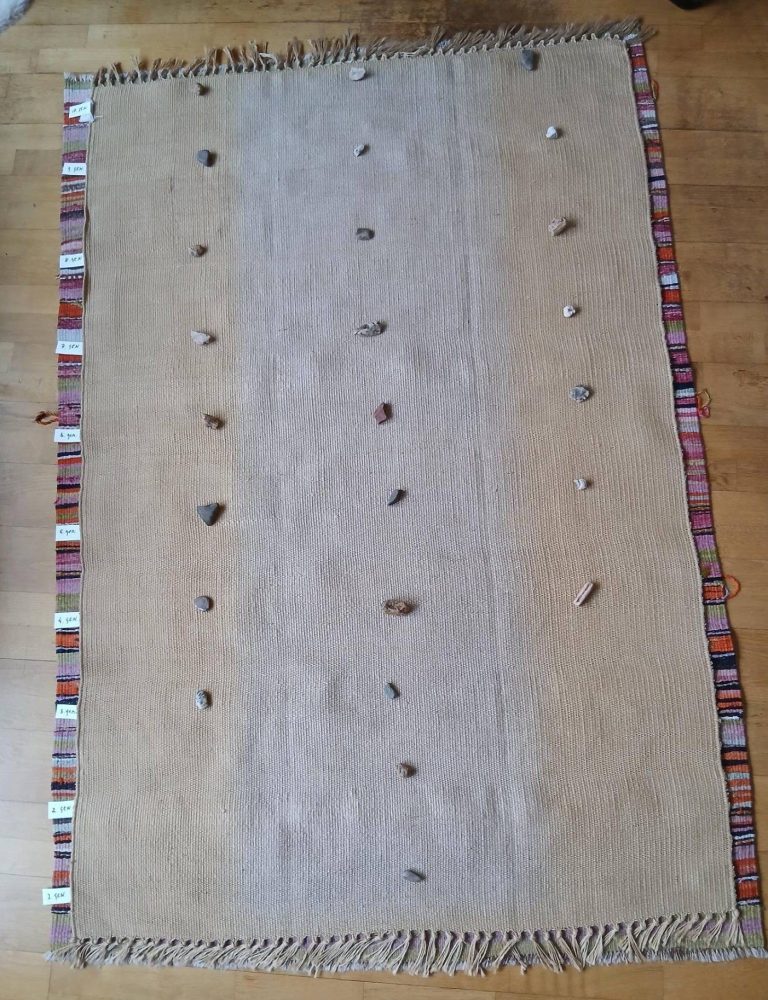
The thematic ancestor constellation
The general ancestor constellation looks like this:
You lay out the four ancestral lines.
First ancestral line:
First generation: mother, one stone.
Second generation: grandmother, one stone.
Third generation: one ancestor, one stone.
And so on up to the tenth generation.
Second ancestral line:
You don't need to lay the first generation because your mother is already represented in a stone.
Second generation: grandfather, one stone.
Third generation: one ancestor, one stone.
And so on up to the tenth generation.
Third ancestral line:
First generation: father, one stone.
Second generation: grandmother, one stone.
Third generation: one ancestor, one stone.
And so on up to the tenth generation.
Fourth ancestral line:
You don't need to lay the first generation because your father is already represented in a stone.
Second generation: grandfather, one stone.
Third generation: one ancestor, one stone.
And so on up to the tenth generation.
The order in which the stones are laid doesn’t really matter, as long as it’s right in the end. You place the stones far enough apart that you can stand between them when you pick up a stone to tune into it.
In the ritual of picking up, tuning into and representing the stones, there is no set order. We limit the number of stones picked up to the number of the thematic ancestor constellation, which is seven. That is sufficient for processing. We choose the stones together by tuning into the field. You don't have to do this alone. If you are not used to this, it may seem very difficult or almost impossible to do, but you will probably really feel something, and a stone will attract you. You, your helper and I have sheets of paper, each with its own colour. When a stone catches your attention, place a sheet of paper next to it so that afterwards we know which stone is linked to an ancestor who wants to be represented and who chose this stone. It may be that all three of us feel a certain stone. In that case, we will all place a sheet of our colour next to it. If you feel a particular stone very strongly, you can indicate this by placing several sheets of paper next to it. Perhaps together we will feel more than seven stones that demand attention, perhaps fewer. That doesn't matter. Perhaps another stone will be added along the way that wants to be seen. It may also be that you do not feel a particular stone pulling at you, but that you choose that that stone should be tuned into and represented, for example your parents or grandparents. You can indicate this with a card stating exactly who you mean.
When we feel that we have finished tuning into the field and we have marked the stones that require attention with a piece of paper, we sit down again and you decide which stone you want to start with. There is no specific order. So you can also start with a stone from the tenth generation, if there are sheets of paper next to it. It makes sense to start with a stone that has many sheets of paper next to it, because that means it is important in the constellation. But it is up to you.
Below is a photo of it.
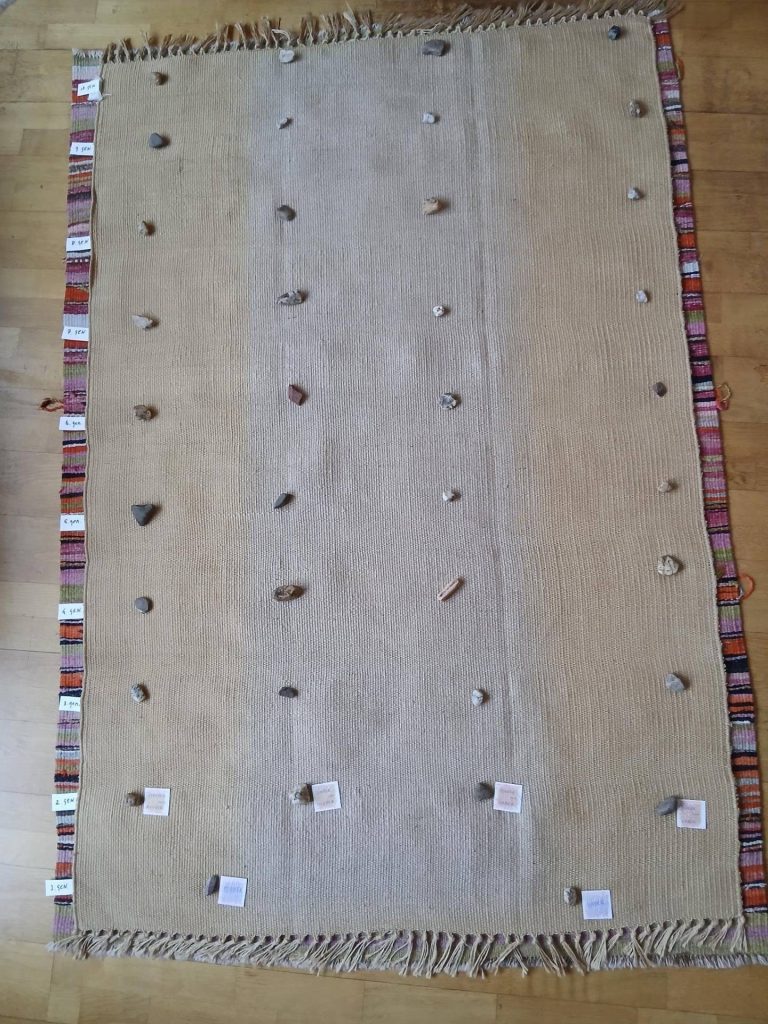
The general ancestor constellation
Strengthening the ancestral line also happens because, for example, ancestors who are not aware of this role are given this missing knowledge through the ancestral ritual. An incident: I am going to represent an ancestor, and a moment later I grab my head with both hands and exclaim: "There's someone shouting in my head! There's someone shouting in my head!: ‘You are on an ancestral line! You are on an ancestral line!...’ It must be my father."
This young man was unaware that he had become a father in that life, and his father saw his chance to finally make him understand this. The young man had previously run away from home, he said, because his father shouted so often. And now again.
We hebben je toestemming nodig om de vertalingen te laden
Om de inhoud van de website te vertalen gebruiken we een externe dienstverlener, die mogelijk gegevens over je activiteiten verzamelt. Lees het privacybeleid van de dienst en accepteer dit, om de vertalingen te bekijken.